Could your building business keep running if you weren't on site for a week?
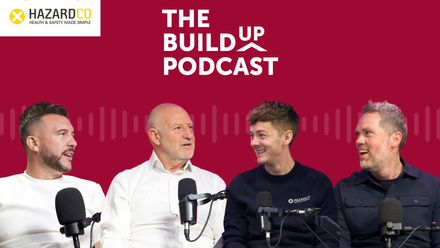
In this episode of the Build Up podcast, host Amy Voce is joined by Matt Bridge, Director of FMB member company Colonial Construction, and Dominic Sheridan, Sales Manager at HazardCo. Alongside FMB member co-hosts Aidan Cropper and David Gutierrez, they discuss how to step back from the tools, delegate responsibility and maintain standards as your business grows.
With 48 years of construction experience, Matt shares what he's learned from building Colonial Construction and developing a team that can run projects without his constant involvement.
Watch the full episode for practical advice from experienced building business owners.
Why getting off the tools matters for building businesses
When you're running a building company, it's easy to spend your days on site and your evenings pricing jobs, ordering materials and managing paperwork.
But as you take on more projects and staff, being involved in every decision can hold your business back.
For Matt, getting off the tools meant learning to trust others with running jobs while finding time to manage the wider business.
The episode explores how builders can make that transition without compromising workmanship, client relationships or their reputation.
The challenges of stepping back from site work
Handing over responsibility isn't always straightforward, particularly when you've spent years building your company's reputation.
From approving purchases and managing subcontractors to dealing with unexpected problems on site, everyday decisions can cause delays when everything depends on the owner.
As Dominic explains:
‘As soon as the point of failure becomes you and your telephone, that's a real issue.’
Matt, Aidan and David discuss the challenges they've faced, including unpredictable workloads, maintaining quality and trusting others to make decisions on site.
How to delegate and keep building projects moving
Stepping back means knowing which responsibilities to hand over and how to keep track of work without being on every site.
The episode covers:
- Site management: Trusting others to run jobs and make everyday decisions.
- Purchasing and payments: Reducing delays when materials or subcontractors need paying.
- Developing your team: Preparing tradespeople to take on supervisory and management roles.
- Project oversight: Keeping jobs on track across multiple sites.
Matt also explains why having a reliable pipeline of work helped him make the transition away from the tools.
Watch the full episode to hear what worked for Matt, Aidan and David, and the challenges they encountered along the way.
Building a team you can trust
Matt founded Colonial Construction in 1989 and has spent 37 years growing the company. Today, he works alongside a wider team of directors, project managers and site managers.
Apprenticeships have played an important role in developing that team.
As Matt explains:
‘The people that run our jobs were our apprentices.’
He discusses how investing in people has helped Colonial Construction develop its own managers, maintain workmanship standards and prepare for succession.
The conversation also explores how to give staff greater responsibility while keeping the oversight needed to deliver quality work.
Using systems and technology to maintain standards
Managing several building projects means keeping track of site progress, purchasing, communication and health and safety.
Dominic Sheridan from HazardCo explains how digital tools can help builders reduce paperwork and maintain oversight without being on site every day.
The discussion covers the limitations of using WhatsApp for important project information, the role of project management software and how technology can simplify health and safety administration.
Matt, Aidan and David also share their experiences of introducing systems into their businesses, including the challenges of getting site teams to use them.
They explore how clear responsibilities, reliable communication and consistent processes can help maintain standards across multiple projects.
FMB membership support for building businesses
Running a building company involves more than managing work on site.
As an FMB member, you can access business advisory helplines and practical resources to help you manage and grow your business.
Find out more about FMB membership
Could your building business run without you?
Hear how experienced building business owners have approached getting off the tools, delegating site management and building teams they can trust.
Matt, Dominic, Aidan and David share practical lessons on managing multiple projects, maintaining quality and reducing the pressure of everyday decisions.
Watch the full episode of the Build Up podcast to find out how you could spend less time on site and more time running your business.
This episode of the Build Up podcast is sponsored by HazardCo.
Full episode transcript
Read the full transcript of this episode below. This has been lightly edited for clarity and readability.
Getting off the tools: how to build a business that runs without you
Build Up Podcast – Episode 1: Getting off the tools: how to build a business that runs without you
[Intro music plays]
Amy Voce (Host): You're listening to The Build Up podcast, brought to you by the Federation of Master Builders. I'm joined as always in the studio by my co-hosts, Aidan Cropper, Managing Director of IPSUM UK Limited in Nottinghamshire, and David Gutierrez, Director of Nest Building Group in Surrey — both proud FMB member companies.
Today, we're talking about a challenge many builders face as their business grows: how do you get off the tools and build a company that doesn't depend on you being everywhere at once? For many building business owners, you start out doing everything yourself, but as you take on more work and more people, your own role has to change too.
So how do you make that transition, build a team you can trust, and put the right systems in place to give you more time to actually run the business? Don't forget to hit subscribe so you never miss an episode.
Today, we're joined by Matt Bridge, Director of FMB member company Colonial Construction. Matt has worked in construction for 48 years and founded Colonial 37 years ago. Since then, he's built a wider team around him, including fellow directors and site managers who help keep projects running smoothly.
And we're joined by Dominic Sheridan from HazardCo, which provides digital health and safety tools to help construction businesses work smarter and spend less time managing H&S admin.
Matt and Dominic, welcome to the podcast.
1:25 — From Sole Trader to Growing Team: Matt's Origin Story
Amy: Matt, you founded Colonial 37 years ago. Can you take us back to the beginning? What did the business look like then, and how different was your role compared to what it is now?
Matt Bridge (Colonial Construction): The business looked like me. That was it. I was the start. I'm a carpenter by trade, so I always wanted to work for myself, and in 1989 I decided I was going to take that leap of faith.
The business started with me and a car — an old Vauxhall Astra. A bit like Richard Branson starting out of the back of a car. We got into a bit of maintenance work, and then we were advertising in the local paper. I knew a few people I could call on if I needed them, and we picked up an extension about six weeks after we started.
We managed to secure the job, and I used some subcontract labour. I managed to find a young guy who came on as a labourer, so then it went from one to three. Then one day the bricklayer went on holiday and I needed a replacement, so I phoned my old firm and asked if I could have a bricklayer for a couple of weeks. They told me they wanted £60 a day, which in those days was a lot of money.
I said, "I can't afford that." I knew who I wanted — one of my old apprentices where I used to work. About two days later he rang me and said, "Have you heard about Thistle?" I said, "No." He said, "They've gone pop. Have you got any work?" I said, "You can start Monday."
[Laughter]
So he started on the Monday, and we finished that job. Then we grew from that to another bricklayer, then a carpenter, and it went from there. I gave myself four years to go from being just me to being able to come off the tools.
3:14 — Turning Points: Finding Repeat Business and Stability
Amy: What were the main turning points as the company grew for you?
Matt: Getting exposure and getting repeat business was a big one. You never know where the next job's going to come from. That's been one of the big things in our industry — the volatility of workload. When there are only two or three of you, it's much easier to find work, but there are times when Pip, who's now my business partner, came to my house on a Monday and said, "Where are we going?" And I said, "I don't know, mate. I'll find something." And I used to find something.
I used to go down to a club I belonged to on Friday nights — lots of estate agents were there — and I'd say, "What have you got for us next week?" It was literally hand to mouth. But four years later, I had enough work to move on to the next stage, and I had four people working for me.
I've always thought the magic flip point is four people working for you, so that you're not having to work all day on the tools, then go home and price jobs, advertise, do the books, and all that sort of stuff. Anything less than that, you're having to do part-time work. We got to the four people within the four years, which was a big thing.
Amy: And that was the point where you felt you could come off the tools?
Matt: Yes. That was the kind of turning point. Most of the time — not all of the time, but most of the time, yes.
4:42 — What Colonial Construction Looks Like Today
Amy: What does Colonial look like today in terms of the team around you and your own role?
Matt: It looks a different picture today. We've got 12 people working in the office and about 25 people out on site. It's a big engine now — we keep calling it an engine, and it needs lots of fuel to keep feeding itself.
I've tried to make myself the least important person in the business. I've been doing that for the past five or six years. The plan is for my succession — I turn 70 in 2029, and my plan is to move to chairman when I get to that point in time.
I've got a very expensive first wife, so I've got to keep working in the meantime.
[Laughter]
David Gutierrez (Nest Building Group): Can we ask — what wife are you on?
Matt: I'm on number two. I got the right one the second time around.
Most of the people who are doing the stuff in the office now are people that have trained through the business. For me, that's been the big part of the succession — having the right people in the business to do the jobs they're doing.
We've been a big advocate of apprenticeships, and we always have apprentices. The people that run our jobs were our apprentices. There's only one that wasn't. Everyone who's come through the business, I've either coached at rugby or know from rugby, or they've been through our process right from youngsters, as teenagers.
We hired a commercial director in May — our first ever one — who's come in to help take the load off me and be more important than I am.
6:07 — Warning Signs: When a Business Is Too Reliant on One Person
Amy: Dominic, you work with building businesses at different stages of growth. Do you see similar challenges where the owner's still trying to keep hold of everything even though the business has grown?
Dominic Sheridan (HazardCo): All the time. People start growing and they start to employ people, but they still really feel that need to be there day to day. They worry about their reputation, they worry about things going wrong with clients, so there's a real tendency to just stick with what they know — and what they know is day to day.
There sometimes needs to be a turning point where you have to start letting go, and that's really difficult and often really scary. Especially for people like you, Matt — you built this business yourself from the ground up. At some point you've got to start giving it away to people, and you're about to do that again in a few years' time. But this time you've got 30 years of experience, so it's a little bit different.
For people who are four years into a business, it's a baby still. It's often your name above the door. It's staff who have a mortgage and kids, and you might know their kids and their partners. It's really difficult to start to transition away, especially when the market is volatile and you don't know where the next job is coming from. Then simultaneously you've got to say to them, "Hey, do you want to stop doing that revenue-generating task and spend an afternoon planning how you're going to step away from this role?" That's a really big ask.
Amy: Do you think there are warning signs that tell you a business has become too reliant on one person?
Dominic: There are some really clear and obvious things. Can somebody else in the business buy something? If you're on a job, something goes wrong, you need to go and buy something — are you the only person with the ability to do that? Are you the only person who can sign off an invoice? Are you the only person who has the contact number for key suppliers?
As soon as the point of failure becomes you and your telephone, that's a real issue. What if your partner is ill, or one of your kids needs to be picked up from school and you just have to leave? It's not a holiday — you've had no time to plan for it. Can your business keep going? If the answer is "sort of, but it would be difficult," there are things you could do pretty quickly to fix that, like somebody else being able to purchase something.
I know it sounds really silly, but a job grinds to a halt when you can't do that. Suddenly everyone goes, "Well, no one's got a card. No one's got an account."
Matt: You just open accounts, don't you?
Aidan Cropper (IPSUM UK): You can have order numbers. Exactly. It's all well and good — simple process.
Dominic: It's not a hard fix, but it is potentially something that gets overlooked very easily.
9:04 — Coming Off the Tools: Aidan and David Share Their Experiences
Amy: Did you guys have that moment, that turning point where you had to come off the tools?
Aidan: I kind of learnt from my previous employer, which made it such an easy process. They made it easy for us to run the business for them, so I made sure that as soon as I had my own company, that's exactly what I did. I opened up accounts with Travis Perkins and Jewson's.
[Laughter]
Amy: Certain other providers are available!
Aidan: Because the tier one builders' merchants, there's more of them around. So when you're doing a job in North London, East London, West London, or Surrey, there's going to be places where they can pick up materials. You have to make it easy for them. Fuel cards, for example, stuff like that.
Matt: We do that. Yeah.
David: We do the same. To be honest, I didn't have the foresight when I first started out. As the company grew and I got more employees, it was exactly what you just said — I got to the point where I was literally paying for everything. Everything was coming through me. It was carnage.
So we put processes in place — credit cards, fuel cards, accounts. But also subcontractor payments. Before, everything was coming through me. Now I have a system I only introduced about a year ago. As you go along, you pick up all these things where you're thinking, "How can I make this easier?"
Our bookkeeper can put everything through now into an approval app called Telleroo. Really, really useful. It links through to my bank, and all I have to do is top that up and approve it. Before, I was spending ages going through, making sure I paid the right things. Now I can just go in and make a lump sum — even for salaries. All the employee wages go through there as well. It makes it so much easier.
Firstly, congratulations, Matt — that's amazing in terms of how long you've been established and what you've built. But having that foresight to say, "I'm coming off the tools in four years" — I'm 15 years into my company now. And the other day, I'm not going to lie, I was still digging out a foundation because I can't help myself sometimes.
[Laughter]
I was like, "We were a bit short. Someone called in sick."
Matt: I was gonna say, mate — can't help yourself!
David: I came off tools — the worst seven years of my life was coming off completely. My mental health wasn't great with just running a business and thinking, "Oh, is this why I came into this industry?" But then you have that day, like I was digging that foundation out, and I was loving it. Then I looked at my phone and thought, "I can't be doing this." I had so many messages.
I've got a consultant at the minute who supports me on the finance side, and I was speaking to her. She said, "What's been going on?" I said, "I'm just so stressed at the minute." She said, "What have you been doing?" I said, "Well, actually, I've been digging." She said, "What are you doing? Why are you digging a foundation? That is so stupid."
Matt: That probably sorted you out, I imagine.
David: Yeah! And she said, "You want the respect off your lads." I do.
Matt: I bet you slept well too, though.
David: I did, yeah.
---
12:30 — Mental Health, Sleepless Nights, and the Construction Business Owner
Matt: The irony is the sleepless nights. I don't think anybody who's listened to this would say they've never had a sleepless night — running your own business is sleepless nights. Cold sweats at 3:00 in the morning and all that sort of stuff. Unfortunately, that's part of what we do.
Sometimes doing a day's work actually is a great release because you are so tired, you fall into bed. You genuinely sleep the sleep of a baby. And then you wake up, and all the problems you had the day before — because you've had a good night's sleep — actually aren't as bad as what they were.
Having your lifestyle balance is massively important. A lot of people can turn to drink and stuff like that — it's very easy to do. We've all been in situations where it's just too much. I get up at 6:00 in the morning and do my training every morning, and that sets me up for my day. That's the way I deal with it.
David: But that's sometimes more tiring, actually. When you're doing paperwork and meetings, you're knackered. You're mentally exhausted.
Amy: And that's not what you probably thought you were signing up for when you went into the trade.
David: Definitely not. This is not who I am.
Matt: When you do a day on the tools, you finish at 4:00 or 5:00, and that's it. You feel like you achieved something. But when you're running the business, it's all the time. It's in your head. It's on your phone. It's never ending.
I think we should allow ourselves to enjoy our successes when we do things, too. What we all do is create things for people to live in, to work in, to be educated in. People get to enjoy the fruits of our labour. I think sometimes we don't celebrate that enough because we've got so much pressure on ourselves, getting onto the next one. You kind of forget about what you've done.
---
14:42 — Making the Transition: What It Takes to Step Away
Amy: Getting off the tools isn't simply about putting down your toolkit. It means changing your role in the company and trusting other people to take on things that might previously have depended on you. So let's start with that transition. Matt, what does it actually take to step away from doing the work yourself and start spending more time running the business?
Matt: Knowing that you've got the work in front of you for two or three months allows you to be more comfortable with the fact you don't have to be working and looking for it every day. And having the people around you that you've employed and worked alongside — to trust them to actually carry on doing what you do when you're not there.
The next thing after that is getting a job that you know you can move them onto after that. That's the big thing, because otherwise you fall back into it.
I've got a mate who was a very clever business administrator, and he said to me after about two years, "You're using your hammer as a security blanket." Which means basically I was too scared to put it down and move onto the next stage. He said, "Your business will never grow unless you put your hammer down and you don't pick it back up again."
It took me two years to finally cotton onto that in the last two years of my four-year plan. That was the big thing for me. You just have to go for it. In the same way as you have to go for it when you start your business on day one — you've got to believe in yourself. You've got to believe that something's going to come round the corner.
---
15:57 — Handing Over Responsibility: What to Delegate First
Amy: What's the first thing for someone who wants to get off the tools gradually? What's the first thing they should hand over?
Matt: The running of a job. That's actually the hardest part, because you're used to doing the books, you're used to running the job, you're used to working on the job. But having someone that you can have as a number two who's going to turn up at the same time you would, who's going to stay for the same amount of time — and not rob you, because that's basically what happens most of the time. People steal time off you. Not materials — they will steal time.
That's the big thing — having someone you can trust to carry on doing what you would be doing if you were on site every day.
Amy: That's so true. 100% on the button. What was the hardest thing to hand over when you made that transition? Which process?
Matt: Partly ordering materials, because you end up just doing it because that's what you've always done. But really also making decisions. Every site, every day, someone has to make decisions that affect the progress and the process. The client wants to change things — it's all those little bits and pieces.
So you hand over something that you think you would do in your sleep to someone who can't do it in their sleep. When you run a business, you do it in your sleep because you think about it all the time. When you employ someone to do it, they can switch off at 5:00 and switch back on at 8:00 in the morning.
---
17:17 — Building Trust: Aidan and David on Delegation
Amy: Aidan and David, how did you decide what still needs your involvement and what someone else can take responsibility for?
Aidan: It depends on who you've got around you. I've managed to build a really amazing team. I've been quite fortunate — my mum works with me, and my dad, and my uncle did. I know they say you should never work with your family, but actually there was a level of trust there from the beginning. They might not have had the exact skillset for the roles they were working in, but there was always trust, and that's built over time.
You've got to be able to delegate, because it is hard to let go. At the very beginning it was really difficult because your reputation is based on you and what you do and your level of standards. To almost delegate that is quite difficult. It took a lot of time for me to do that.
David: I've been through the same process, even with the finance stuff. It's very hard to let that go, even though there's an approval process in there. It felt like I was losing a little bit of control over what was being spent. That was so difficult, because it's your baby, isn't it? You start up and it's your baby. You know how it clicks, you know how the business runs.
But you've got to do it, because otherwise you'll never grow. A lot of people say, "Without you, it won't work" — but you can be the face.
I've had James, who's absolutely amazing. He's worked for me for 22 years. He's that guy. He will turn up when I turn up. He will leave at the same sort of time. He won't nick time off you, which I think is definitely the biggest issue in our industry, especially when you're not on site and you're not present.
You can employ foremen or managers, which I've done. They nick time. Everyone's there because time is money.
David: Think systems as well, though. If you've got the systems in place, then they have to follow those systems, which gives you a little bit of control back. So you don't necessarily need to be there to make sure those systems are being adhered to.
---
20:03 — Systems vs. Reality: When Process Meets the Building Site
David: Let's put ourselves in the scenario where we're on a project right now, and the steel's turned up late — they've turned up at half three. We have to get them in because there's a roof that's open. The client didn't pay for a tin hat, for example. Your guys clock off at 4:00. You need them to work till 6:00, and this is a must. This is when you usually turn up, and you've got your faithfuls that turn up. A system is broken.
Matt: A system to run a business, yes. But to run a site — sites don't work that way, Aidan.
Aidan: There's a combination though, isn't there? It's trust and picking the right guys that work for you.
---
20:57 — Why Processes Alone Can't Replace People and Culture
Amy: Dominic, when builders start delegating more, how important is it to have processes in place before they hand the responsibility over? Is there a way to help that?
Dominic: David, you're absolutely right. Processes can't solve for people always. People will, with all the will in the world, do the things they want to do if they really want to do it.
I have a friend who works for a big restaurant chain. They have to sign in — they have to be in the Wi-Fi area of the restaurant to sign in. They found the furthest point away they can sign in on the Wi-Fi. They've got round it. There's a system in place, but the culture's not there.
You have to combine systems and culture, and if you combine the two, that's when it becomes really powerful. When thinking about delegation, putting the customer at the heart of what you do allows that culture to coalesce around it.
Culture's nebulous — it's the thing we can't see and touch. Having that sentiment of "we do right by the customer," that's the lens that we look at everything through.
Matt: The most important thing running a business is your customer. You could look at it as let's put the business first. It's the wrong way round. Your customers are your business, because without them they don't exist.
Dominic: Exactly. If you act with "how do we put the customer first?" and then reverse engineer things backwards, processes allow you to keep a certain amount of control. They give you oversight. You can say, "Hey, I don't love this — I can see something in a process here." But it won't solve everything. If you go to someone and say, "You took 34 minutes off me yesterday," they don't care. It's very hard to make them care.
But if the culture is built around "we do right by our customers," and it's 4:30 and you've got to work till 6:00 because we do the right thing for our customers, and maybe you reward them on the back end —
---
23:10 — Building Company Culture: Respect, Accountability, and Team Investment
David: It's also building culture within a company. Go out and do team-building. Go and spend money on your staff and treat them, and then they start respecting you. Trust me, that works. It really does work. You're not their mate, so you make sure you have boundaries. You're their boss, but you also care for them.
Yes, you can have that time off — you make sure you highlight the fact that you are saying, "Yes, you can drop your kid off because your wife's working late." I'm a father myself — go for it. If it keeps happening, you need to address it.
Building respect is the most important thing. And accountability. Accountability doesn't mean coming down on somebody like a ton of bricks when they do something wrong. Accountability means, "Yes, I made a mistake, and what are we going to do to address it?"
Matt: Absolutely. That comes from everybody, whether it's the managing director saying, "I made a mistake," or whether it's the person who's been there one day. A culture of accountability allows you to make forward progression rather than a rearward-looking "let's have a problem" approach.
David: But as a boss, you have to be that boss. If you don't feel that's being reciprocated by a member of staff who is so good at their job, you need to let them go. You don't want them guys to create a rotten fruit bowl. Super important to keep your finger on the pulse in your business. Systems or processes or whatever you want to call them — at the end of the day, it's you and the guys that you're employing to be the leaders.
---
25:18 — Can AI and Technology Help Builders Let Go?
Amy: We've talked quite a lot about AI and how rapidly that's helping businesses. Do you think technology can make it easier, Dominic, for a business owner to let go if they put those systems in place?
Dominic: 100%. AI's only as good as what you put into it, so be mindful of what you use in your business. I wouldn't rely on it in court, for instance. But AI can really help somebody in taking that step away.
If you've only got a certain amount of time off the tools and you're trying to make that transition, where can something like AI really help? Where can you automate or semi-automate your day? Could you set thresholds for expense approvals and ask an AI provider to check and flag the ones that look like issues? Does that win you back half an hour? And then more interestingly, what can you do with that additional 30 minutes?
Amy: Exactly, yeah.
Dominic: Systems and technology can give you back time. Small gains — it's a marginal gain, but it's a compounding gain. What does that mean at the end of the month? How many hours have I gained because I implemented a system that was simple? Maybe someone else could do the system for you.
---
26:30 — FMB Member Resources: Business Advisory Helplines
Amy: Some great insights there. Don't forget, all FMB members get access to extensive business advisory helplines to help manage and grow their businesses. Visit fmb.org.uk/membership to learn more.
---
26:42 — Building a Team You Trust: The Apprenticeship Pipeline
Amy: Stepping back only works if you have good people around you who you can trust to take responsibility and maintain the standards your business has built its reputation on. So let's talk about building that team. Matt, how have you built a team that you trust to run projects and maintain the standards when you're not there?
Matt: It's taken a long time. All the time you're doing jobs around the same level, you're always hoping to get an opportunity on a bigger job. Everybody who sets up their own business wants to get to a level where they can grow. It's almost like having a ticket in the lottery — if you don't have a ticket, you're not going to win.
We got a great opportunity after about 10 years to build five lovely houses. We'd already elected to take on apprentices before that, because I'm a great believer in re-investing in and keeping our industry alive. I'm also a big rugby man, and I've always said that a business without apprentices is a rugby club without colts. You have to have a future.
My growth and my trust in the people that work for me now is firmly rooted in the fact that most of those were my apprentices. We've taught them. Pip, who's my business partner, he was an apprentice, and then he taught two of our best bricklayers, and they taught the others. We've had a perpetual cycle of guys learning their trade and growing within the business.
That trust is based on the fact we've known them since they were 16 or 17 years old, and some of those guys are in their 40s now. They're project managers or site managers now.
---
28:55 — The Gatekeeper: Maintaining Standards When You're Not on Site
Matt: I'm the gatekeeper. I've got my name over the door. When Pip used to go out and start running jobs, he would actually say to people before it got to snagging, "You're not gonna let Matt see that, are you?" Because he knew what I would say when I got on site and saw it.
That's been one of the hardest things for me — giving people the trust to actually be the gatekeepers. I'm not the gatekeeper anymore now, but I get wheeled out. The big gun gets wheeled out every now and then. If it's important, I'll go and show the young guys how I snag jobs. I don't want the architect snagging my work. I want to hand over a job that's near enough perfect.
I'm sitting there sometimes in my office and I can hear these conversations, and I'm thinking, "I want to get involved here." But you have to learn to not sweat the small stuff. You have to let them get on with it and make their mistakes, and then correct them. It's only a mistake if you do it once.
You make a decision on whether someone's good enough by the level of mistakes they make, or their attitude to how they work with their teammates. Our team is a team from top to bottom. Everybody's as important as everybody else.
I say, "You do your job to the best of your ability, which allows me to do my job to the best of my ability. You deliver, and I get the next job in. As long as you keep delivering good quality, you're making my job really easy."
---
30:09 — The Business Partner Dynamic: Matt and Pip's 37-Year Journey
Amy: Have you had a business partner since inception?
Matt: No, I started it. Pip became a shareholder in 2002. He was working in the business from three months in. We started in July of 1989, and he started on the 1st of October.
Amy: He was the brickie from your old firm?
Matt: He was the brickie from my old firm. He's been in our business man and boy. He went out and played rugby in New Zealand for a year with a mate of mine. But apart from that, he's been a Colonial man. And now he's a business partner.
Amy: How have you found that? How's he found it?
Matt: We hate each other with a vengeance and we love each other like brothers. We have our ups and our downs.
Amy: Like family.
Matt: He's my brother. He's family. We fight like cat and dogs, but we'll put an arm around each other and go and have a beer. We hold each other up on Friday night after the Saints game. In the pub afterwards, we talk about what we're doing on Monday morning. He's got my back and I've got his. Absolutely. Always been that way.
Amy: Do you feel like that had a positive impact on your growth?
Matt: I think so. He's the guy that actually does the stuff on site, and I've been the one that's had to learn how to run a business. I never knew how to do that. We make people laugh because we say, "We're just a couple of Herberts." He's a bricklayer and I'm a chippy. And they go, "Well, you're pretty successful Herberts."
We've got good quantity surveyors, and we send our people on courses so they know more than we do about what they do. If I'm the most intelligent person in the room, I'm in the wrong room. So I want people who are brighter than me.
---
32:19 — Software Systems for Project Management and Purchase Orders
Amy: It's obviously very important to have site managers and wider management teams like that, because then it allows you to step back and hand the responsibility over.
Matt: Our project managers — we were talking about the software before — we have a really good software system where all of the project managers do all of the purchase orders for subcontractors and every stick of material that comes onto a site. When the invoice comes in, the software checks the invoice against the PO. If it doesn't have an order number on it, it doesn't get paid.
Those boys do all that between them and the site managers. They've all got access to it. I don't even get to see any of that stuff anymore now.
---
32:49 — Accepting That Others Won't Do It Your Way
Amy: What have you learned about giving people responsibility and keeping an oversight as the business owner?
David: It's hard. I'm a very particular person. I'm actually difficult. I'm very particular compared to John — I'm the bad cop, he's the good cop. I think you need that mix.
It's very difficult to hand over the reins when you are very particular. All my clients, if any of them were listening to this podcast, they'd know how particular I am. I have severe OCD, not just at home but at work as well.
Not everyone's going to be like you. You need to accept that. That's the biggest thing for me — they're not going to do it like the way you want it, but they're going to do it their way, and you have to accept that.
Matt: And the scary thing is when the numbers get bigger, it gets even more scary, because you're trusting them with even more of your money. You can't help yourself listening to conversations.
We've grown into the space where our conference room had to be turned into the project managers' room, so we built a new conference room downstairs. It's like the bear pit in there. They all rub off each other, and they can all hear each other having these conversations, so they're all learning off each other every day — how they manage contracts, how they manage subcontractors. Some are really comfortable and quiet, and some are quite aggressive on the phone. Some are really commercial and want to get a deal off the subbie, and some just accept the price and go with it. And they all question each other. It's actually really good.
David: We have a similar culture to that, actually, where everyone's feeding into everything. We still try to get together on a Friday at 5:00 just to have a quick pint. It's just a chat. The passion in that room is amazing.
---
35:18 — Financial Decisions: Investing in Your Team as You Grow
David: One question I've got — in terms of when you were growing, how did you handle it financially? I've got a QS now and people in the office, but every time I've made that decision to make that investment, I found it really hard. It's only as I've got more control over the finances with cash flow forecasts that it's given me clarity on whether we can make that investment. How did you find that, growing your team?
Matt: I kind of lurched from one crisis to another. It was like, well, we need a QS now, and a guy came available. We'd had some hard financial times, and he came to the business, and I was really nervous about it. But an architect who we used to do a lot of work for said, "A good QS will pay his own salary. So if you think he's the right guy, take him on."
A lot of it is not your judgment. It's actually someone allowing you to make the decisions you want to make that you're not sure about. In 2010 we took on a QS who's now basically running a lot of our office for us.
Then you get to a point where you can't do everything yourself with project managers. We went from having me and Pip looking after jobs with site managers, to thinking, well, we need a project manager in between us now, because we're getting spread too thin.
We go, "Who of our current guys have we got who could step up to that level?" That process is evolving literally weekly. One of our young project managers, who's only been doing it for a year and a half, said, "I'll do it" when we needed a temporary works coordinator. He was a bricklayer a year and a half ago. Now he's priced two jobs in the last three weeks, and he's won them both.
---
37:30 — Stop Using WhatsApp for Business-Critical Tasks
Amy: We talk a lot about trust, Dominic. From what you see, how can systems and processes help an owner give more responsibility without feeling like they're losing control?
Dominic: Those systems and that trust — you have to have the right people. But once you've got that in place, those systems are what allow you to step away.
Thinking about health and safety, with all the will in the world, if someone's not on site, they don't know certain things have happened or haven't happened. Having a system in place that gives you that oversight is key.
A piece of advice we give people all the time is: stop using WhatsApp for business-critical things. WhatsApp's great. We use it all the time. It's really effective. But it's not a great communication tool when something is really important. You can't track it. No one has real oversight on it. You get a casual message — "I'm late, do you want anything from the shop?" — and then there's a really important piece of information that you're trying to get out to everybody.
As you grow, you need to have a system that scales with you. WhatsApp is fantastic for quick conversations. It's not a system that scales. What works when you've got five members of staff doesn't work when you've got 40 members of staff across five jobs.
Amy: What would you suggest if people are using WhatsApp? What is a practical solution?
Dominic: Things like email — it makes it nice and reportable. There are lots of systems out there with task management tools. For things that are site-related, using a task on a job management system is a really helpful way. Phone calls followed up with messages — it doesn't have to be some fancy system, but it has to be something that allows you to get it reported and scalable.
David: I think AI can help with that as well. A lot of the meetings we do now have AI tracking, so it documents everything automatically, which is amazing.
Matt: The other thing is we use WhatsApp a lot because a lot of the guys that work for me are of an age where they're not very technological. They can use WhatsApp. I tried giving them iPads and SharePoint and OneDrive, and it's like, I might as well not bother. So we use WhatsApp, but then we have somebody in the office linked to all the WhatsApp groups, and they extract the information as and when we need it. I'd like to implement more systems, but getting the guys on site to actually use them is quite tricky.
Dominic: To sum up, WhatsApp really has its place. This isn't bashing WhatsApp. But it needs to be used mindfully, because as you grow, it can become a beast of itself.
David: It's all about things getting lost — documents, casual conversations, constantly scrolling.
Dominic: I was on holiday two weeks ago, and a group work WhatsApp had 200 messages in it. How do I know as a business owner what's important out of those 200 messages? I've got no idea. Lots of that is just chat, and that's fine. But coming up with ways of differentiating "what's just stuff" and "what are the things I really need to know" — that's where the differentiation has got to be.
---
41:26 — Maintaining Standards Across Multiple Sites
Amy: Dominic, when you've got different people responsible for different sites, how do you make sure everyone is working to the same standard?
Dominic: It comes back to accountability. Having a really clear understanding of what needs to be done and how it needs to be done from the beginning. There's a saying: what gets measured gets done. People need to know what they're being measured against, and what happens if that doesn't work out — what do they need to know, how is it going to be put right?
How are you going to manage quality when you're not there? Good people are a huge part of it, but as you take on more work, you also need ways of keeping track of what's happening without every question and decision still coming back to you.
---
42:28 — Managing Multiple Jobs: The Gatekeeper Dilemma
Amy: That brings us to how you manage the business as it grows. Matt, as the company grew and you had several jobs running at once, how did you learn to keep an oversight of everything without having to be on every site yourself?
Matt: That was really difficult. The truth is we didn't probably manage that process very well, because I kept trying to be on every site every day. Then me and Pip shared that load. Then we went to project managers who went to site every day, and site managers we felt we could trust. But even now, Pip still is the gatekeeper.
Last week, we had two quite big jobs on. The groundworks contractor did two 90-degree bends in one run of drains on one site, and our own guys did two 90-degree bends in one run of drains on another site — on the same day. Pip came back to the office with steam coming out of his ears. He said to the two site managers, both experienced, both know what's going on, "Why would you let that go? Why did you not say something?"
I genuinely think that problem doesn't really go away. I think you've got to have a gatekeeper. We're now looking for a Pip number two. You need someone on site who's prepared to pick up the things, because when you're a site manager on site day in, day out, you sometimes genuinely don't see the wood for the trees.
I genuinely don't know what the full answer is. Even if you're dealing with a subcontractor who should know better and your own guys who should know better, and they still do it — I think you just have to have eyes and ears.
---
45:18 — Succession Planning: Investing the Next Generation
Amy: Do you think your Pip number two will have to be invested into the business for them to care that little bit?
Matt: Yes. The guy we're looking at is someone we'll be looking to make a partner, basically. The succession plan — my kids don't want it.
Amy: The kids don't want it!
Matt: The likelihood is the business will go to some of the younger generations, and the one who we think's going to be number two will be a shareholder. They'll grow into that role because they've also been our apprentices too. You can't have stake ownership before you have ownership.
David: It's a tricky one. It's handing over that responsibility and trying to take that workload away, but it's actually adding a bit of workload, isn't it?
---
46:10 — Health and Safety Technology: Why Word Documents Aren't Enough
Amy: Dominic, where do you see builders spending time on health and safety processes which could be made much simpler?
Dominic: From a health and safety perspective, there are fundamentals people need to hit on every job. The HSE are really clear about that. Doing things on paper, editing Word documents at 11 o'clock at night, is not the way you scale a business. Technology like HazardCo can really help with that. There's lots of automation and flexibility in the software.
Health and safety is one of those things you can't avoid. The legislation is really clear, and you have to meet certain obligations. People get lost in it — it's a bit of a quagmire, a bit of a minefield.
It pains me when I speak to people every week who say, "I'm still editing a Word document." I think it's 2026. It's nearly 2027. You can do better than that.
---
47:35 — Technology That's Actually Working for Builders
Amy: Aidan, David, have you introduced any technology that's really helped with that workload?
Aidan: I like HazardCo. They're great. They're superb. We use them, don't we, Matt? It's a great tool. I suggest members that are listening jump on it. It'll make your life a lot easier.
David: Same. On the operational side, we still use SharePoint and OneDrive, and it works really well. It's cloud-based, links through to iPads on site. Some of the guys struggle with technology, which is always going to be a bit of a battle. But health and safety is one thing that technology really does help with, I think. In terms of the operational side and having those eyes, it's so important. Every single day.
That's what's great about construction — you're learning all the time as you make your way through this journey. But it also can be really frustrating.
Matt: It's massively important that guys go home safe every day. We use a cloud-based system. The emails come to us, and we know when the site managers have done their walk-around. It comes on a PDF, and if they haven't done it, it flags up.
We also have a collaboration board on every site so that everybody — every subcontractor — collaborates with each other. People put their dates on the board. But the other thing is that as they walk into site, there's a sign that says, "Nothing you do on site today will be more important than you going home to your family tonight." And that's the first thing our guys see when they go on our jobs.
---
49:21 — What Freedom Looks Like After 37 Years
Amy: We've talked about changing your own role, putting good people around you, and using systems and technology to take some of the pressure off. So let's finish with what all of that can ultimately give you as a business owner. Matt, after 37 years of building Colonial, what does having a business that isn't completely dependent on you allow you to do differently?
Matt: It gives me some freedom, which is massively important. I devote time to the CITB, I devote time to the Federation of Master Builders. I'm a construction ambassador — going into schools trying to get kids into construction. Having the ability to do more of that on a daily basis has been a big deal for me, because it's starting to allow me to plan for my retirement.
But also, it gives me a lot of pride that the people who are doing what they do in my business every day are people that I know, love, and see all flourishing in their own environments. It's really cool. It's really wonderful.
---
50:29 — Dominic's Challenge: Test Whether Your Business Really Needs You
Amy: Dominic, if a builder's listening thinking, "My business couldn't run a week without me," what's the first thing you'd suggest they change?
Dominic: I'd almost challenge them on the premise of the question. Is that true? Try it. Go and spend a week on holiday. Treat yourself. Put some guardrails in there, but encourage your staff to actually see what happens when you step away.
A thing I do with my team is I ask them, "Come to me with what you think you should do next." Rather than asking me, "What should I do next?" — come to me with, "I think I should do this next. Am I right?" And nine times out of 10, they're right. So just give people that little bit of rope, and they will run with it.
Put some guardrails in place, but take a week and see what actually happens in your business, and that'll tell you an awful lot about what you need to change when you come back.
---
51:19 — Outro: Where to Find Everyone
Amy: I love that. Well, Matt and Dominic, thank you so much for joining us today on the podcast. Where can people find you if they'd like to find out more? Dominic?
Dominic: hazardco.com, or follow us on social media.
Amy: Amazing. And Matt?
Matt: buildcolonial.com, or mattbridge@buildcolonial.com.
Amy: And Aidan and David, remind us where we can find you.
Aidan: On the socials and ipsumuk.com.
David: nestbuildinggroup.com, and on Instagram — Nest Building Group and Nest Bathrooms.
Amy: If today's conversation has got you thinking about how you could free up more time to focus on running your business, we'd love to hear from you. Email buildup@fmb.org.uk and tell us what's worked for you.
And if managing your business operations better is something you're thinking about, we'll include more information about HazardCo and the support they offer in the episode description.
Thank you again to Dominic for joining us today, and to the HazardCo team for sponsoring this episode to help us provide you with useful business tips and advice.
And if you're looking for support to help you run and grow your building business, visit fmb.org.uk/membership to find out more about FMB membership.
Please like, subscribe, and hit that bell icon so you're the first to hear about future episodes. Thanks for joining us on The Build Up podcast, brought to you by the Federation of Master Builders. Join us next time for more tips and ideas to help your business grow.
[Outro music plays]
---
Key topics covered in this episode:
- Getting off the tools in construction
- Building a company that runs without you
- Delegation and trust in construction management
- Apprenticeships and growing your team
- Systems and processes for construction businesses
- AI and technology for builders
- Health and safety technology (HazardCo)
- Mental health and wellbeing for business owners
- Construction business succession planning
- FMB membership benefits
- WhatsApp vs. proper business systems
- Culture and accountability in construction
Relevant links:
- FMB Membership: fmb.org.uk/membership
- Colonial Construction: buildcolonial.com
- HazardCo: hazardco.com
- IPSUM UK: ipsumuk.com
- Nest Building Group: nestbuildinggroup.com
- Email the show: buildup@fmb.org.uk
Subscribe and never miss an episode


Watch more in the series


Authors
The Build Up Podcast
Build Up is the FMB podcast for builders tackling the real-world challenges of running and growing a building business in the UK.


