Even the most established builders in the trade can benefit from an effective business development strategy. Whether you’re looking to take on bigger projects, grow your team, or have a more stable pipeline, the right business development plan will help you attract the right kind of customers and ultimately, take your business to the next level.
In this guide, we break down each stage of designing a business development plan. We’ve also included a free downloadable template designed specifically for builders, giving you a ready-made framework to win business.
Business development objectives
Before creating your business development strategy, it’s important to know what you are looking to achieve. These questions will help you to shape an effective business development strategy for growth:
- Are you promoting existing services, or looking to add new ones?
- Are you trying to reach new audiences? If so, who are they and which problems do they need solving?
- What makes you stand out and do you communicate this in your branding?
- How can you offer something different to, or better than your competitors?
How to write a business development plan
Every business development strategy should be designed to attract prospects, grow engagement and convert potential customers.
Here’s how you can write a business development plan for builders in 6 steps.
1. Decide on a lead generation plan
To attract new business, you need to work out the best types of content to share, using your customer and competitor knowledge to guide your decisions.
It’s important to take resources and budget into account, as well as choosing a combination of marketing approaches that will reach your target audience.
Here are just some of the ways that you can grow brand visibility and take prospects on a journey that converts them into customers:
- Networking
- Social media
- Website content
- SEO
- Facebook groups
- Online advertising
- Print advertising
- Trade shows
- Featuring in publications
- Email marketing
- Phone calls
- Local directories
A great place to start is to choose the methods of lead generation that you think are most likely to reach your target customers. Once you have decided on your approach, take time to decide how often you would like to promote yourself and any particular times that might be most useful.
For example, builders that specialise in energy efficient home upgrades could benefit from advertising their services regularly as the weather gets colder, putting them at the front of homeowners’ minds when they look for a solution.
This will give you a plan of the types of promotion that should work best, as well as the most suitable times to launch each lead generation method.
2. Engage and build relationships with potential customers
After capturing the attention of a potential customer, it’s time to build trust and nurture these relationships. This can be done by responding quickly to enquiries, offering free site visits, showing reviews, giving helpful follow-ups, sharing examples of previous work and communicating honestly and clearly.
The key to engaging customers is to solve their challenges, responding quickly and giving them confidence in your work.
3. Convert customers
Once you have attracted and engaged your target market, it’s time to convert them into paying customers.
There are many different ways to encourage a customer to make a final decision. For those that like to visualise a project, showing 3D drawings and providing detailed breakdowns alongside quotes can help to secure projects.
For others, limited-time discounts, payment plans, appealing and realistic timelines and customer service can convert customers.
Last, but certainly not least, friendly communication goes a long way in giving customers the confidence that you are the right business for the job.
4. How will you monitor business development and success?
Business development needs adjusting to make it as cost-effective and successful as possible.
The best way to achieve this is to make sure you keep a record of your business development approaches, as well as the results.
To track success, useful metrics can include referrals, enquiries, uses of promotional codes, website visits, revenue growth, reviews, or simply asking customers how they heard of you.
5. Review
This stage involves looking at the data that you have collected to work out which lead generation methods are working and which need upgrading.
Use any stats that you have collected to make sure your efforts are worth your time. Not every approach will bring immediate results, but this is a great way to spot any trends.
6. Adapt and repeat
Finally, it’s time to adjust your business development strategy and repeat. Work out where your new leads are coming from, repeat anything that’s working and regularly make tweaks to improve.
It really can be that simple to find a winning business development strategy for builders.
Download your free business development plan template
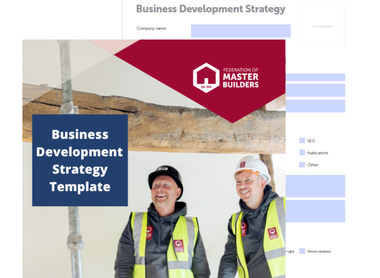
- FMB members: Log in here to download your free business development plan template.
- Non-members: If you're not yet a member, complete the short form below to download the template to help build a more profitable, resilient business today.